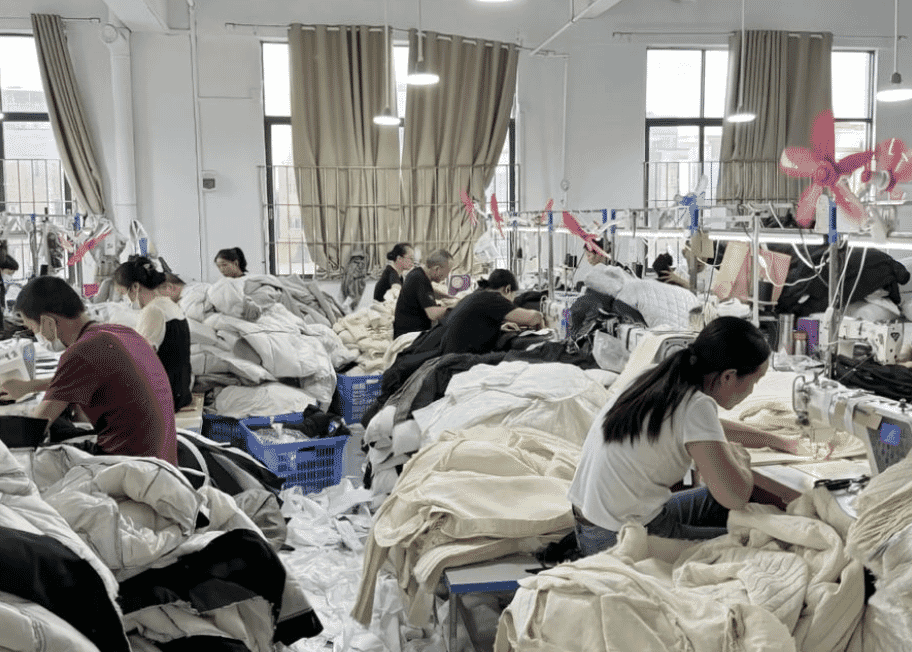
A clothing supplier in China is any company that will sell you finished garments. That single sentence hides the whole problem. Some of them own the machines. Some own nothing and forward your brief to a factory forty minutes away, adding a margin you never see.
China shipped $165.24bn of apparel in 2024, keeping it comfortably ahead of every other exporting country (Sheng Lu, FASH455, citing WTO data, 2025). The scale is not the hard part. Working out which of the thousands of companies quoting you actually cuts and sews is the hard part.
This guide covers what the categories really mean, where production is concentrated, what it costs once tariffs are counted, what minimums to expect, and how to check that a supplier exists before you send money.
Note: China Clothing Manufacturer is a group of documented clothing factories in China, producing for brands from 100 units. Ranges in this guide come from published industry sources and are given as market ranges, not as quotes from a specific factory. We confirm exact MOQ and price with the factory when you send a brief.
Key takeaways
- China exported $165.24bn of apparel in 2024, still world number one by a wide margin.
- Its share of world clothing exports fell to 29.6%, the lowest since 2010, while its share of textile exports rose to 43.3%.
- Five provinces produce over 70% of China's garment output. Zhejiang alone is 25.5% of national textile and garment revenue.
- US duty stacks in three layers, and two separate Section 301 actions are routinely conflated by trade blogs. Verify your own HTS code.
- Typical market MOQ is 500 to 1,000 pieces per colourway. Smaller runs exist with a narrower set of factories.
- "Supplier" covers factories, trading companies and agents. Only one of the three owns the machines.
- Verify the business licence before any deposit. It is the single check that filters most fraud.
What Does "Clothing Supplier in China" Actually Mean?
The term covers three different business models, and the difference decides your price, your lead time and who is accountable when a shipment is wrong. Most brands discover which one they hired only after the first production run goes badly. Almost every sourcing problem a first-time brand meets traces back to not knowing which of the three they are dealing with, because a supplier profile rarely says.
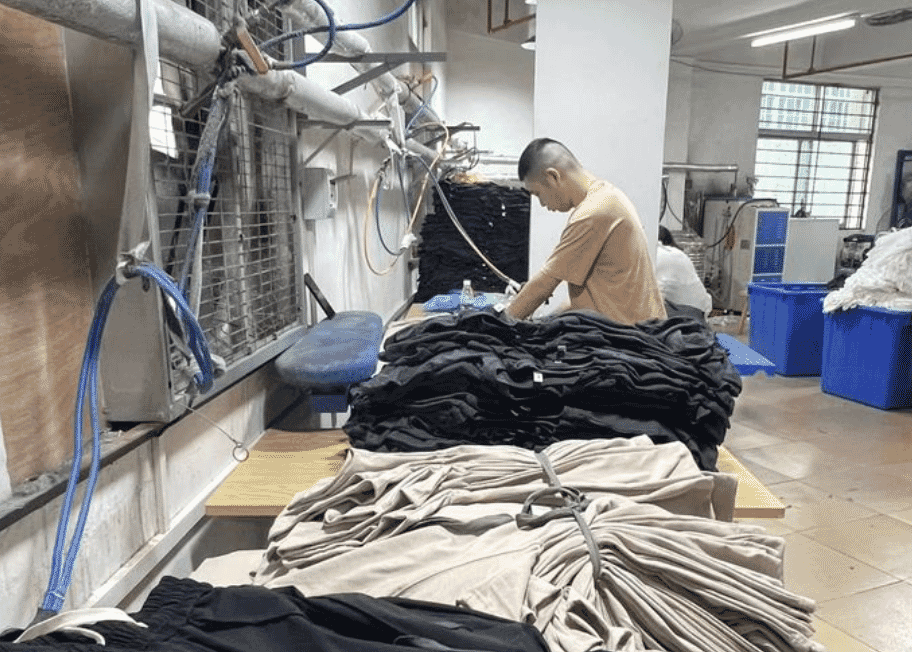
A factory owns cutting tables, sewing lines and usually a sample room. It quotes on its own capacity and it cannot take work it has no machines for. That constraint is useful to you: a factory that says no to your product is telling you something true.
A trading company owns no production. It holds relationships with a set of factories, takes your brief, places it, and adds a margin. This is not automatically bad. A good trading company absorbs the coordination work and carries the quality risk. A bad one is a layer of cost and a broken telephone.
An agent sits further back again, usually charging a commission on your order value. The incentive problem is structural: an agent paid a percentage of what you spend has no reason to push your unit cost down.
How to tell them apart in one question
Ask: "Can I have the business licence and the address of the production floor?" A factory sends both without hesitation. A trading company will usually admit the arrangement when asked directly. Anyone who deflects twice has answered you.
Citation Capsule: China's clothing suppliers fall into three models: factories that own production, trading companies that subcontract and add margin, and agents paid a percentage of order value. Only factories are constrained by their own machine capacity, which is why a factory declining your product is a more reliable signal than a trading company accepting it.
Not sure which one you're talking to? Send us the company name and we will tell you what they are, at no cost. Send it here.
Our guide to telling a trading company from a factory sets out the four questions that settle it.
How Big Is China's Clothing Industry in 2026?
China exported $165.24bn of apparel in 2024, more than any other country, but its share of the world clothing trade fell to 29.6%, the lowest since 2010 (Sheng Lu, FASH455, 2025). Meanwhile its share of world textile exports climbed to 43.3% from 41.5%.
Those two numbers moving in opposite directions is the most useful fact in this guide. China is losing finished-garment share to Vietnam, Bangladesh and Cambodia, and gaining share in the fabric that those countries sew.
For a brand, the practical reading is this. If your product is fabric-led, China's position is strengthening. If you are chasing the lowest possible cut-and-sew labour rate on a simple garment, the gap with Vietnam and Bangladesh has narrowed for a reason.
What Does the Export Data Actually Tell a Brand?
Two numbers moved in opposite directions between 2023 and 2024, and almost nobody reads them together. China's clothing export share fell to 29.6%. Its textile export share rose to 43.3% (Sheng Lu, FASH455, 2025). Read separately they look like decline and growth. Read together they describe a single move up the supply chain.
Our reading is this. China is exporting fewer finished garments and more of the fabric those garments are made from. The sewing is migrating to Vietnam, Bangladesh and Cambodia. The mill supplying them is still in Zhejiang.
That has three practical consequences for a brand choosing where to produce.
If the fabric is the product, China got stronger
A performance knit, a specialist weave, a coated or bonded fabric: the capability concentration is increasing, not decreasing. Sourcing that fabric in Vietnam often means sourcing Chinese fabric with an extra pair of hands in between.
If the garment is simple, the gap has closed
Basic cut-and-sew on woven cotton is exactly the work that has been leaving. You are no longer choosing China for the cheapest sewing labour in the world, because it is not that, and has not been for several years.
If you move production, check where the fabric comes from
Moving a programme to Vietnam to change the country of origin does not automatically change where the fabric originated, and origin rules turn on more than the final assembly point. Ask your supplier where the greige goods were woven before you assume a duty position has changed.
Citation Capsule: Between 2023 and 2024 China's share of world clothing exports fell to 29.6% while its share of textile exports rose to 43.3%. The two figures describe one shift: garment assembly is migrating to Southeast Asia while fabric production concentrates further in China. Brands moving assembly out of China frequently keep sourcing Chinese fabric without realising it.
Where Are China's Clothing Factories Concentrated?
Five provinces produce over 70% of China's garment output: Guangdong, Zhejiang, Jiangsu, Fujian and Shandong (China National Garment Association). Zhejiang alone generated 1.12 trillion yuan, about $162.21bn, in textile and garment revenue in 2025, which is 25.5% of the national total (China Daily, 2026). They are not interchangeable. Each cluster grew around a material, a skill or a port, and that history still decides what each is good at, which makes the region a supplier-selection decision before the factory is.
Which region suits which product
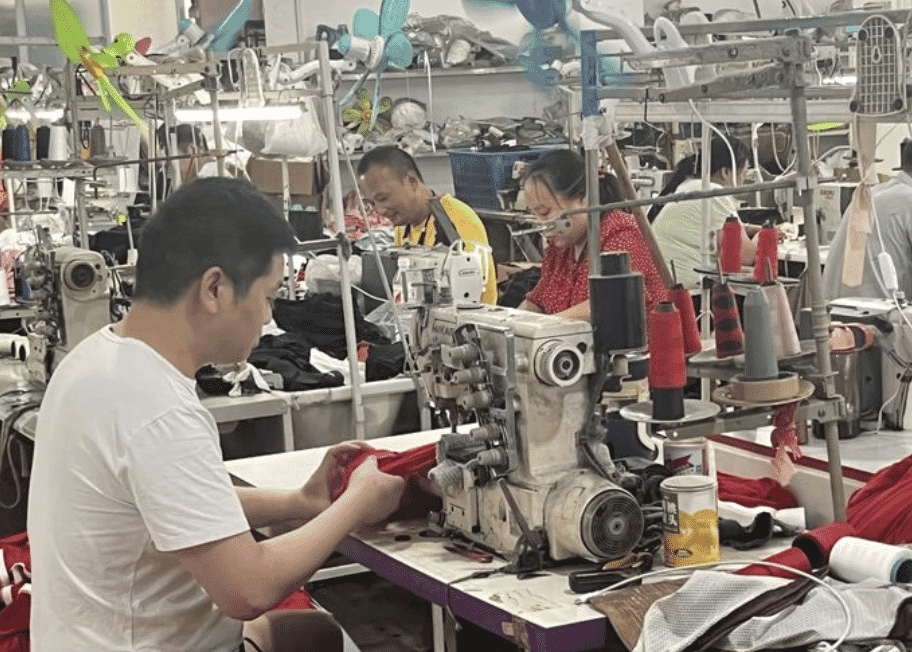
Guangdong, and Guangzhou in particular, is the practical base for most small and mid-sized apparel brands. The cut-and-sew density is highest here, sampling turnaround is fastest, and the fabric markets are within driving distance of the factories.
Zhejiang leads on fabric, yarn and synthetic fibre, and hosts the Yiwu distribution complex. It is where you go when the fabric is the product.
Jiangsu and Shandong skew to larger-volume and more technical production, including performance fabrics and outerwear.
Fujian, especially Jinjiang and Quanzhou, is the footwear and sportswear cluster.
Citation Capsule: Chinese garment production is geographically concentrated. Five provinces, Guangdong, Zhejiang, Jiangsu, Fujian and Shandong, account for over 70% of national output. Zhejiang alone generated 1.12 trillion yuan of textile and garment revenue in 2025, 25.5% of the national total, and $95.33bn of textile exports, 32.4% of the national total (China Daily, 2026).
| Province | Built for | Go here when |
|---|---|---|
| Guangdong | Fashion apparel, streetwear, fast turnaround | Trend-led product, small to mid orders, short lead times |
| Zhejiang | Fabric, silk, socks, knit materials | The material defines the product, or you need silk or hosiery |
| Jiangsu | Sweaters, knitwear, tailoring | Structured garments and wool knitting |
| Fujian | Sportswear and performance apparel | Athletic product, especially bordering on footwear construction |
| Shandong | Work gloves, coated goods, home textiles | Protective or household products rather than fashion |
Regional specialisms, not a quality ranking. Good factories exist outside their region's speciality; starting in the right cluster shortens the search.
What Do Chinese Clothing Suppliers Cost in 2026?
Unit price is the number brands ask for and the least useful one. Duty is where China deals change shape, and the position in 2026 is unusually unsettled. Three layers stack, and you need all three before a landed cost means anything.
Layer one is the MFN rate, set by your product's HTS classification. It varies widely across apparel, which is why two garments from the same factory can land at different duty.
Layer two is the legacy Section 301 action on China's technology-transfer and intellectual-property practices, which applies additional duties across four product lists. USTR keeps the current lists and the exclusion process on its Section 301 tariff actions page, and opened a second four-year review of that action in May 2026 (Federal Register, 2026).
Layer three is new and frequently misreported. In 2026 USTR concluded a separate set of Section 301 investigations, initiated 12 March 2026, into economies that failed to enforce a prohibition on importing goods made with forced labour. The Trade Representative determined 12.5% as the appropriate rate, applying to entries on or after 12:01 a.m. eastern on 24 July 2026 (Federal Register notice of actions, 2026). This is a different action from layer two, covering a different set of economies, and several trade blogs have merged the two into a single headline rate. They are not the same thing, and which layers apply to your goods depends on origin and classification.
Do not quote a landed cost from any article, including this one. The 2025 IEEPA reciprocal tariffs were later ruled unlawful by the Supreme Court, and the 2026 actions are still moving. Confirm your HTS code against the live USTR and CBP schedules, or have your customs broker do it, before you price anything.
| Cost component | What it covers | Who quotes it |
|---|---|---|
| CMT | Cut, make, trim. Labour and factory overhead only | Factory |
| Fabric and trims | Often 50 to 60% of unit cost on a simple garment | Factory or you, if you nominate the mill |
| Sampling | Pattern, proto, fit rounds, pre-production sample | Factory, usually per style |
| Freight | Sea or air, plus origin and destination handling | Forwarder, not the factory |
| Duty | MFN rate by HTS code, plus Section 301 layers | Your customs broker |
| Inspection | Pre-production, inline, pre-shipment | Third party or your routing partner |
Try it free: pressure-test your landed cost with the China production cost calculator. 60 seconds, no email required.
Get the quote on the same terms every time
A quote is meaningless without its Incoterm. FOB Shenzhen and DDP your warehouse are different numbers describing the same garment. Ask every supplier for FOB at the named port, then add freight and duty yourself. Comparing two DDP quotes from two suppliers compares their freight forwarders, not their factories.
A full breakdown of what a garment costs to make, and how to check a quotation against it, is in our guide to what it costs to manufacture clothing in China.
What MOQ Should You Expect From a Chinese Supplier?
Most Chinese factories quote 500 to 1,000 pieces per colourway for cut-and-sew production. Knitwear that needs yarn dyeing usually sits higher, because the dye lot, not the sewing line, sets the floor. Smaller runs exist, but with a narrower set of factories and a different cost structure.
Two distinctions decide whether a number is real. Per style and per colourway are not the same: 500 pieces across five colours is five dye lots, and most factories will price it as five orders. And an MOQ quoted on fabric is different again, since mills hold their own minimums that the garment factory simply passes through.
We work from 100 units. That is unusual for China and it is worth being plain about why: it is possible on some categories and some factories, not across the board, and the honest answer to "can you do 100 pieces" depends entirely on what the garment is.
Skip the search: the China factory directory ($39) lists documented factories by category, city and capability, with the verification status of each. One-time payment, instant download.
Want the real minimum for your product? Send the garment type, the fabric and the colour count. We come back with the MOQ a factory will actually accept, usually within 24 hours. Send the brief.
Where minimums actually originate, and the four structural levers that reduce them, is covered in producing in China at small quantities.
How Long Does Sampling and Production Actually Take?
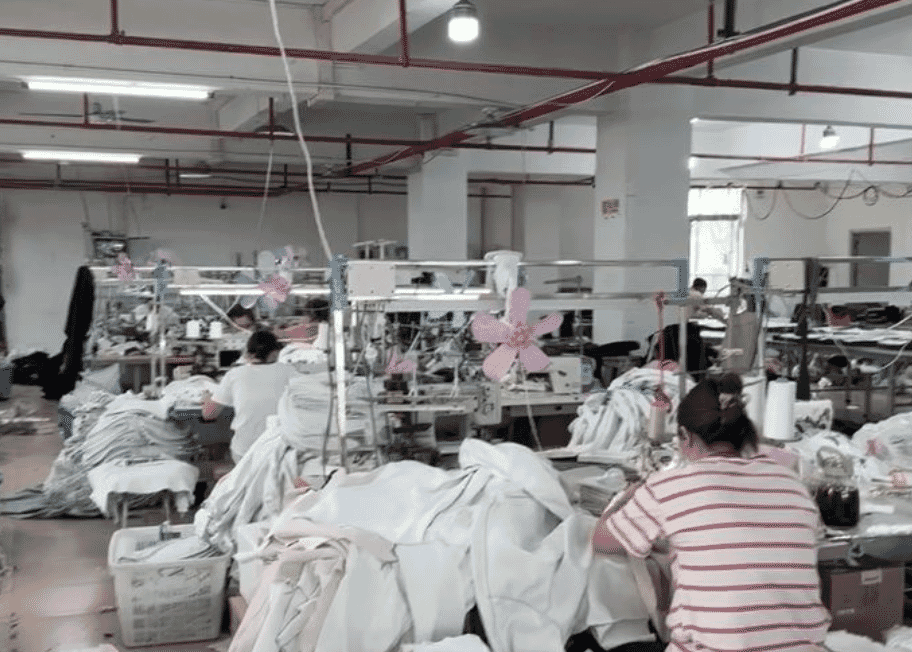
Brands budget for production time and forget sampling, which is where most calendars break. The sewing is rarely the long part. Getting the sample right, and getting the fabric to the factory, is. Expect two to three fit rounds on a straightforward garment and more on anything structured, then a pre-production sample in final fabric before bulk begins.
A realistic sequence runs pattern and first proto, then one to three fit rounds, then a pre-production sample signed off before bulk cutting starts. Each round is a shipment in both directions. If you are three time zones away and reviewing by courier, the calendar cost of a single extra fit round is larger than the sample itself.
The fabric clock runs separately
Stock fabric is quick. Custom-dyed or custom-woven fabric is not, because the mill has its own minimum and its own queue, and the garment factory cannot start cutting until it arrives. When a lead time slips, the fabric is the usual reason, not the sewing line.
Plan around Chinese New Year, every year
Chinese factories close for roughly two to four weeks around Chinese New Year, which falls in late January or February depending on the lunar calendar. Output drops before the break as workers travel, and ramps slowly afterwards as staff return unevenly. A shipment due in February is really a shipment due in January or March.
Two other dates matter less but still bite: the Golden Week holiday at the start of October, and the two Canton Fair windows, when factory sales teams are in Guangzhou rather than answering your emails.
Citation Capsule: Chinese garment lead times are usually set by fabric, not sewing. Custom-dyed or custom-woven fabric carries the mill's own minimum and queue, and cutting cannot begin until it lands. Factories also close for roughly two to four weeks around Chinese New Year, which falls in late January or February, with reduced output either side of the break.
Working to a delivery date? Send the date first and the product second. We will tell you whether it is achievable before anyone quotes a price. Send the brief.
The full sequence from approved sample to loaded container is in our guide to the garment production process in China.
How Do You Verify a Chinese Clothing Supplier Is Real?
The business licence is the check that filters most fraud, and almost nobody asks for it. Every legitimate Chinese company has one, it carries a unified social credit code, and the registered scope tells you whether the company is licensed to manufacture or only to trade.
- Business licence. Ask for the scan. Check the company name matches the bank account exactly. A mismatch between the two is the most common single sign of trouble.
- Registered scope. "Manufacturing" and "wholesale and retail trade" are different registrations, and they answer the factory-or-trader question without anyone having to be honest with you.
- Certifications. Ask for the certificate number, not the logo. OEKO-TEX runs a public label check, and amfori BSCI publishes how its audit system works. A logo on a website is not evidence.
- The address. A production address and an office address look different on a map. Ask which one it is.
- A live video call from the floor. During Chinese working hours, unannounced, walking. This is the single most informative twenty minutes you will spend.
Never send a deposit before the business licence is verified and the receiving account matches the registered company name. That one rule prevents the overwhelming majority of losses.
How we check a factory before routing work to it
- Business licence pulled and the unified social credit code checked against the registered name.
- Registered scope read, to confirm manufacturing rather than trade only.
- Certificate numbers verified in the issuing body's own database, never accepted as a logo.
- Production address confirmed as a facility, not a registered office.
- Live video walk of the floor during Chinese working hours, unannounced.
- Receiving bank account name matched to the licence before any brand sends a deposit.
If a factory fails any one of these we do not route work to it, and we tell you which check it failed.
Citation Capsule: Verifying a Chinese clothing supplier starts with the business licence, which carries a unified social credit code and a registered business scope that distinguishes manufacturers from trading companies. Certification claims should be checked by certificate number in public databases such as the OEKO-TEX label check, never accepted as a logo on a supplier website.
Verification continues after the order: our guide to pre-shipment inspection, AQL and defect lists covers the checks during production.
Where Do Brands Actually Meet Chinese Suppliers?
The Canton Fair remains the largest single meeting point. Phase 3 covers textiles, clothing and footwear, and the fair as a whole connects a very large international buyer base with suppliers across its phases (China Import and Export Fair). The 2026 Phase 3 dates were 1 to 5 May and 31 October to 4 November.
Trade shows are good for discovery and poor for verification. A company can exhibit at a fair without owning a sewing machine. Treat the fair as a way to build a shortlist, then run the licence and video-call checks afterwards on everyone who made it.
The alternative route is the wholesale markets, which serve a different purpose entirely. Guangzhou's fabric and garment markets are for sourcing material and buying finished stock, not for commissioning production to your own pattern. Confusing the two wastes a trip.
How to prepare for it and work the halls is covered in our Canton Fair guide for clothing buyers.
When Is China the Wrong Answer?
China is not automatically right, and a supplier who never says so is selling rather than advising. Three cases where it usually is not. Three situations account for most of them, and in each the issue is structural rather than a question of finding a better factory. Recognising which one you are in saves months of searching for a supplier who was never going to solve it.
Very small runs of complex garments. At 100 to 300 pieces of a tailored or heavily constructed style, European nearshore production often lands at a similar total cost once freight, duty and the cost of a failed sample round are counted. Portugal and Turkey both become competitive here.
Short lead times into Europe. Sea freight from South China to Rotterdam plus customs is a long clock. If your calendar is measured in weeks, the tariff arithmetic stops mattering.
Duty-sensitive categories into the US. With Section 301 stacking on MFN rates, some HTS codes reach a point where Vietnam or Cambodia wins on landed cost even at a higher unit price. Run the duty number before the unit price, not after.
The tariff position also explains why so many Chinese manufacturing groups now operate Vietnamese and Cambodian lines. If your supplier has one, moving production is a conversation rather than a new search.
Frequently Asked Questions
What is the minimum order for clothing suppliers in China?
Most Chinese factories quote 500 to 1,000 pieces per colourway for cut-and-sew production, and many quote higher for knitwear that requires yarn dyeing. Smaller runs exist but they sit with a narrower set of factories. We work from 100 units. Ranges come from published industry sources. We confirm exact MOQ and price with the factory when you send a brief.
What tariffs apply to clothing imported from China to the US in 2026?
Duty stacks in three layers: the MFN rate set by your HTS code, the legacy Section 301 action on China's technology-transfer practices, and a separate 2026 Section 301 action on forced labour at 12.5%, effective 24 July 2026. Those last two are different actions and are often conflated. Confirm your specific code against the live USTR and CBP schedules.
Is China still the largest clothing exporter?
Yes. China exported $165.24bn of apparel in 2024, keeping it well clear of any other country. Its share of world clothing exports fell to 29.6%, the lowest since 2010, while its share of textile exports rose to 43.3%. China is losing finished-garment share and gaining fabric share.
Where are China's clothing factories concentrated?
Five provinces produce over 70% of China's garment output: Guangdong, Zhejiang, Jiangsu, Fujian and Shandong. Zhejiang alone generated 1.12 trillion yuan of textile and garment revenue in 2025, 25.5% of the national total (China Daily, 2026). Guangzhou in Guangdong is the practical base for most small-brand apparel sourcing.
How do you verify a Chinese clothing supplier is real?
Ask for the business licence and check the registration number, request the specific certification records rather than logos, confirm the address matches a production facility rather than an office, and run a video call from the factory floor during working hours. Never wire a deposit before the business licence is verified.
Before you send a deposit
- Ask for the business licence and compare the registered name to the bank account, exactly.
- Read the registered scope: manufacturing, or wholesale and retail trade.
- Ask for the production address and confirm it is a facility rather than a registered office.
- Run a live video call from the floor during Chinese working hours, unannounced.
- Get every quote on FOB at a named port so you are comparing factories, not forwarders.
- Confirm the MOQ is per colourway, not per style, and get it in writing.
- Check certificate numbers in the issuing body database rather than accepting a logo.
These seven take an afternoon and remove most of what goes wrong in the first order.
Conclusion
China remains the largest clothing supplier base in the world, and the $165.24bn it exported in 2024 is not about to be displaced. But the shape of the opportunity has changed. Finished-garment share is drifting to Southeast Asia while China's grip on fabric tightens, which makes the country a stronger choice for fabric-led products than for the simplest cut-and-sew work.
The practical difficulty is not finding suppliers. It is telling factories from traders, getting a quote on consistent Incoterms, and confirming the company exists before money moves. Those three checks eliminate most of what goes wrong.
And the duty position deserves the first look, not the last. With Section 301 stacking on MFN rates and the legal position still moving, a unit price you negotiated hard can be undone by an HTS code you never checked.
We are a group of documented clothing factories in China, producing for brands from 100 units. Tell us the garment, the quantity and the fabric, and we route the brief to the factory in our group built for it, normally within 24 hours. You work directly with the factory. Flat fees, no factory commissions.
Get in contact Download the directory ($39)Need a tech pack? Get a factory-ready single-style tech pack for $79. See what's included.
Editorial note: all company names, certification marks and trademarks referenced here are the property of their respective owners. MOQ, cost and lead-time figures are market ranges compiled from the published sources listed below, not quotes from any individual factory, and they vary by product, fabric and season. Tariff figures were correct at the date of publication and the 2026 position is still moving. Always verify your own HTS classification and confirm terms directly with the factory before committing.
Sources
- China National Garment Association, Industry Overview: provincial concentration of garment output and the national cluster map.
- Sheng Lu, FASH455, University of Delaware (2025): WTO-based analysis of global textile and apparel trade patterns.
- Statista: China's share of global clothing exports, historical series.
- China Daily Ningbo (2026): Zhejiang textile and garment revenue and export figures.
- Federal Register (2026): Notice of actions in the Section 301 forced-labour investigations, 12.5% rate, effective 24 July 2026.
- Federal Register (2026): Initiation of the second four-year review of the China technology-transfer Section 301 action.
- Office of the United States Trade Representative: Section 301 tariff actions and exclusion process.
- US Customs and Border Protection: trade remedies and duty administration.
- OEKO-TEX Label Check: public verification of certificate numbers.
- amfori BSCI: social audit system documentation.
- China Import and Export Fair (Canton Fair): official fair information and phase structure.
Related Reading
- Activewear Manufacturers in China: MOQs, Fabrics and Costs
- Guangzhou Clothing Manufacturers: A District by District Guide
- Alibaba Alternatives for Clothing Production
- How to Find a Clothing Manufacturer in China
- Importing from China: Duty, Freight and Documentation
No commissions. No markups. The factory bills you directly.
